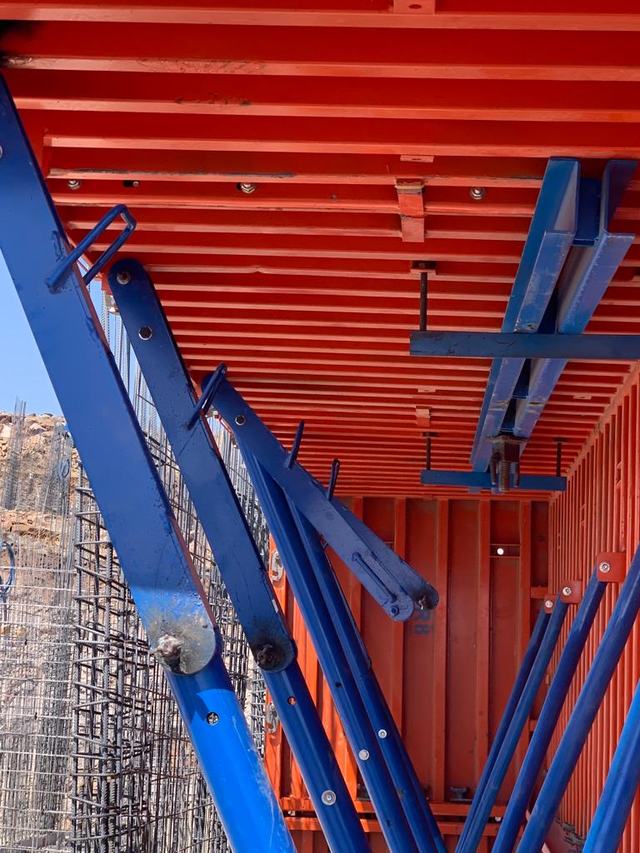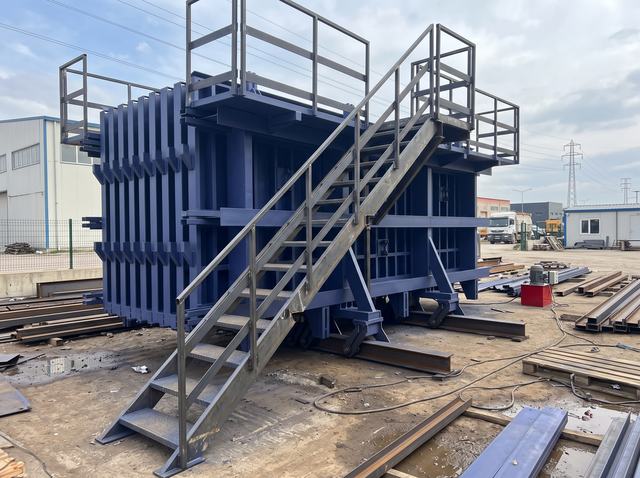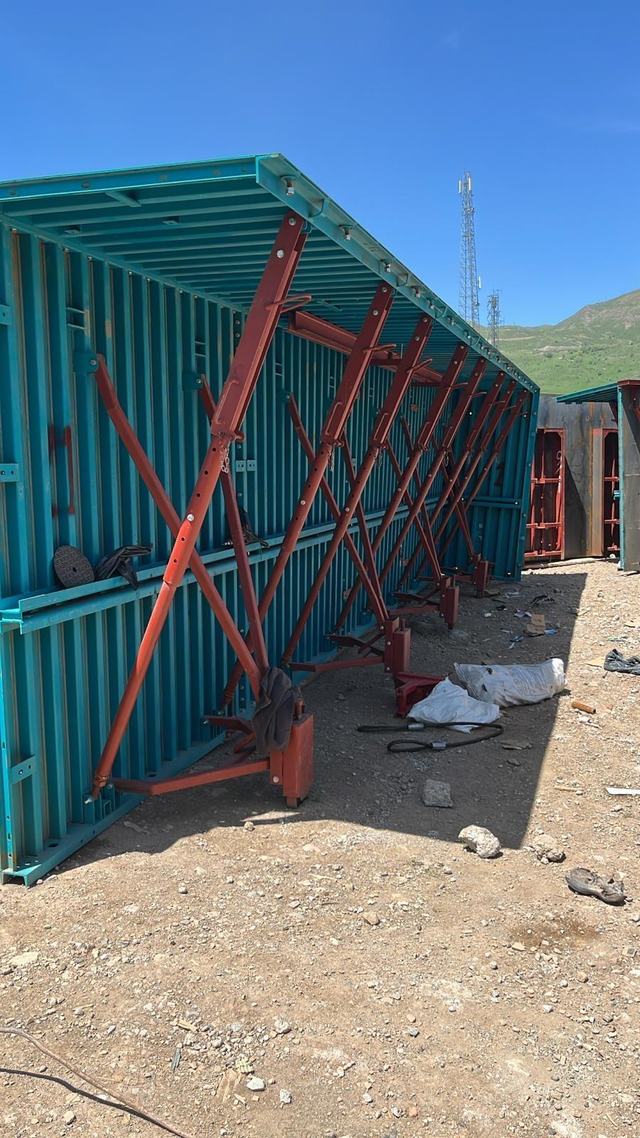

Precast means that a reinforced concrete element is cast in advance, in a controlled factory environment rather than on site, and is transported and erected once it has hardened. The fundamental difference from in-situ casting is where, and under what conditions, the concrete sets.
Precast versus in-situ
| Precast | In-situ | |
|---|---|---|
| Place of production | Factory | Site |
| Curing conditions | Controlled, often steam | Dependent on weather |
| Formwork | Steel, hundreds of cycles | Mostly timber/panel, limited cycles |
| Surface quality | High and repeatable | Variable |
| Weather | Does not affect production | Winter and rain stop work |
| Erection | By crane, fast | Form–rebar–pour–wait |
| Size limit | Limited by transport and crane | No limit |
| Economic threshold | Repeating elements | One-off and complex geometry |
Steps in the plant
- Mould preparation — the contact face is cleaned, a thin film of release agent applied, edge profiles set to the required dimensions.
- Reinforcement and cast-in items — mesh or bar reinforcement, lifting anchors, electrical conduits, insulation and connection plates.
- Casting — concrete is placed; vibration is applied according to consistency, or self-compacting concrete (SCC) is used.
- Curing — by steam, hot water or covering. With steam curing an element reaches stripping strength within a few hours.
- Stripping and lifting — edge profiles are removed and the element is lifted by its anchors.
- Finishing and storage — touch-up, labelling, stacking in dispatch order.
- Erection — placed by crane on site and the connection details completed.
Two things govern cycle time in this chain: curing speed and how easily the mould strips. With a well-designed mould, one mould yields an element a day — sometimes two with steam curing.
Which elements are precast
Structural elements
- Beams: rectangular, I, L and LT sections
- Columns: with corbels and sockets
- Slabs: TT, double-T, flat units
- Wall panels and shear panels
- Roof trusses and purlins
- Stair flights and landings
Infrastructure and site elements
- Box culverts, irrigation channels, gutters
- Barriers, kerbs, parapets
- Gullies, manholes, pipes and conduits
- Sleepers, foundation pads, sockets
- Tetrapods and coastal protection blocks
- Retaining wall units, lego blocks
What precast brings
- Speed — factory production runs in parallel with site work; elements are cast while foundations are still going in
- Quality — curing and dimensions are controlled; the surface is repeatable
- Independence from season — winter conditions do not stop production
- Less site labour — formwork and scaffolding work moves into the plant
- Less waste — the mould is used hundreds of times
Its limits
- Transport — element length and weight are limited by road and crane capacity
- Connection details — connections are the critical point of a precast structure and must be resolved in design
- Repetition requirement — the economics disappear where every element differs
- Upfront investment — moulds, cranes, steam lines and storage area are needed
Where the mould fits in
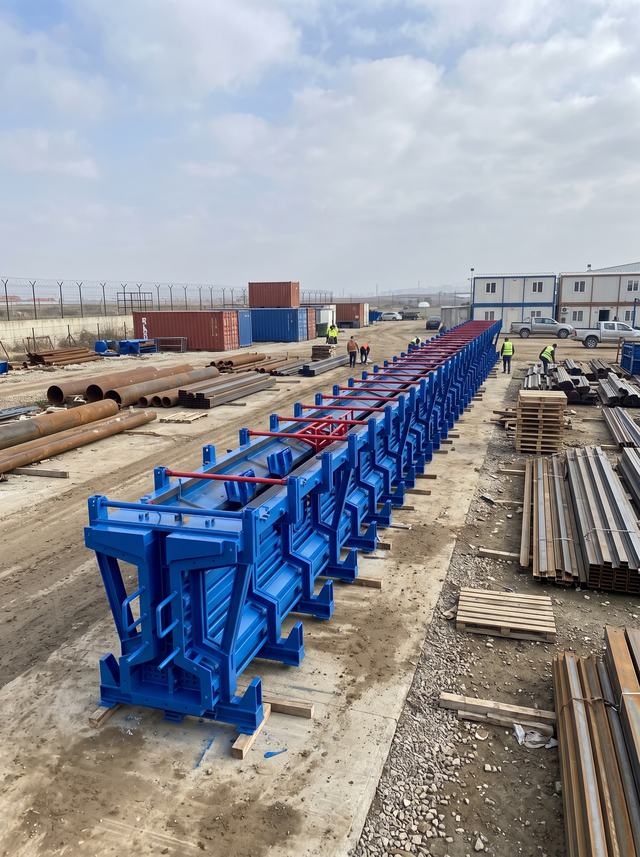
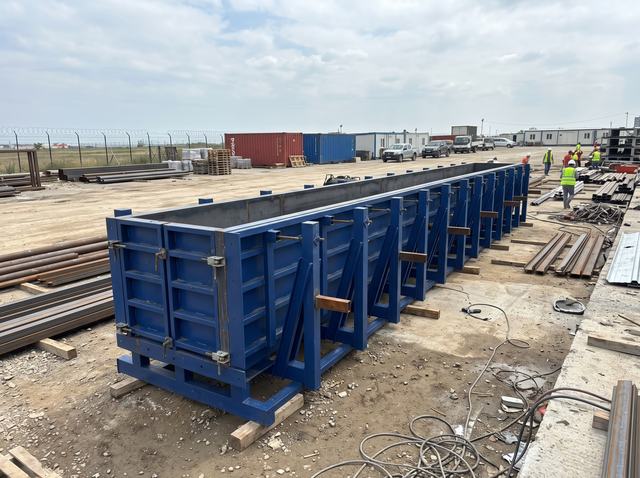
What limits the capacity of a precast plant is usually not the batching plant but the number of moulds and the cycle time. The mould determines:
- the dimensional tolerance of the element
- the surface quality
- the daily output, through stripping speed
- the cost per cycle over its service life
For that reason the mould is not an item to leave until last when setting up a plant; it is a principal investment that has to be thought through together with the line layout.
In short
Precast moves reinforced concrete production from the site into the factory, bringing speed, quality and independence from the weather. The gain depends on the element repeating and on the mould being designed for that production scenario.
PRODUCT GROUPS IN THIS ARTICLE
Let us work out the right formwork configuration for your project.
REQUEST A QUOTE