
Most defects on a concrete face come not from the concrete but from the formwork and how it is used. Below are the defects seen most often on site, their causes and where the correction belongs.
Blowholes
Round voids 2–15 mm across on the surface.
Cause: Air bubbles stuck to the form face cannot escape.
Remedy
- Apply release agent sparingly and evenly; excess agent traps bubbles
- Keep pour layers to 40–50 cm and vibrate each layer
- Insert the vibrator vertically and withdraw slowly; do not rest it on the panel
- Vertical and inclined faces need longer vibration
- Stiffer consistencies produce more blowholes; match consistency to the pour
Colour variation / mottling
Light and dark patches across the same element.
Cause: The absorbency or temperature of the form face is not uniform; release agent unevenly spread; different concrete batches used.
Remedy
- Use the same form material over the whole face; do not mix steel and timber on one element
- Spray the agent and wipe it back — no wet sheen should remain
- Clean rusted areas; rust colours the concrete
- Use a single concrete batch per element
- Keep curing conditions equal on all faces
Honeycombing
Voids where aggregate is exposed and no mortar has reached.
Cause: The concrete was not compacted, or grout leaked from the form.
Remedy
- Make joints leak-tight; seals and firm latches
- Reduce aggregate size where reinforcement is congested
- Increase vibration in congested areas
- Keep free fall below 1.5 m; use a tremie or hose
Fins and steps
A ridge or step at panel joints.
Cause: Panel joints out of alignment; play in hinge pins; latch not fully closed.
Remedy
- Replace pins with more than 1 mm of play; do not fill them with weld
- Check that every latch is fully closed before each pour
- Measure panel flatness with a straight edge every 100–150 pours
Bulging
Widespread, regular convexity across the face.
Cause: Fresh concrete pressure above the design value; tie spacing opened up; panel section insufficient.
Remedy
- Keep the pour rate at the calculated value
- Never skip a row of ties — one missing row more than doubles the moment
- In cold weather setting is delayed, so the same rate means higher pressure; slow down
- Widespread bulging means the panel needs reinforcing; that is a design issue, not a practice issue
Rust staining
Brown runs on the face.
Cause: Rust on the form contact face, tie wire ends, or reinforcement too close to the surface.
Remedy
- Store the form dry and protect the contact face with a thin oil film
- Turn tie wire ends inward
- Set the cover correctly and use enough spacers
Dusting
The surface powders under the hand.
Cause: Excess release agent; water pooling on the surface; premature drying.
Remedy
- Agent consumption should be 20–40 m² per litre; 10 m² per litre means too much
- Do not shorten the curing period or expose the surface early
Cracking
Plastic shrinkage cracks — in the first hours after casting, in wind and heat. Cover the surface and start curing immediately.
Thermal cracks — temperature difference between core and surface in thick sections. Limit heating and cooling rates in steam curing.
Stripping cracks — early or forced stripping. Do not force the form before stripping strength is reached; release gradually with the jacks.
Quick diagnosis
| What you see | Look here first |
|---|---|
| Round voids | Release agent quantity, vibration |
| Mottled colour | Agent spread, rust, concrete batch |
| Exposed aggregate voids | Joint tightness, compaction |
| Step at a joint | Hinge pin, latch |
| Widespread convexity | Pour rate, tie spacing |
| Brown runs | Rust in the form, tie wire, cover |
| Dusting | Excess agent, early drying |
In short
Most surface defects are solved by formwork maintenance, release agent discipline and pour control. Widespread bulging and recurring steps, however, are design and maintenance issues — there, the formwork itself has to be addressed.
PRODUCT GROUPS IN THIS ARTICLE
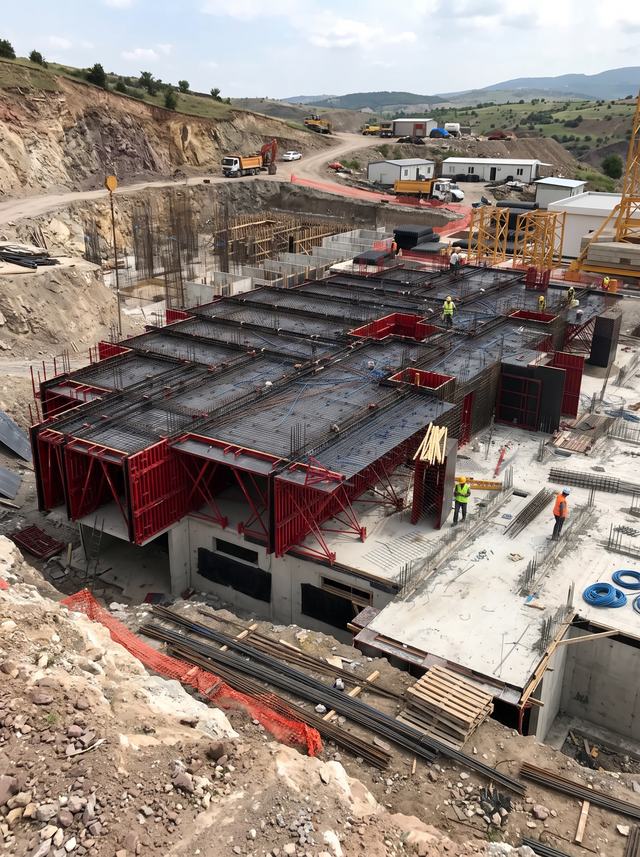
BUILDING TUNNEL FORMWORK
Half-tunnel steel formwork casting load-bearing walls and the slab in a single operation.
VIEW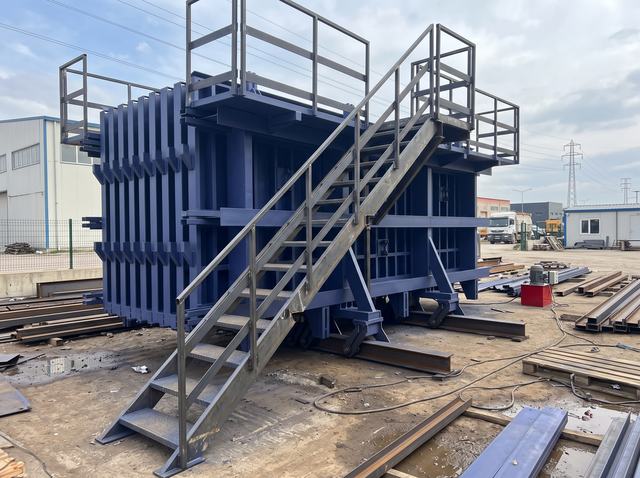
BATTERY MOULD
Vertical multi-cavity mould system for wall panel production.
VIEW WALL PANEL MOULDWALL PANEL MOULD
Horizontal production mould for façade and partition wall panels.
VIEWLet us work out the right formwork configuration for your project.
REQUEST A QUOTE